Accounting & Financial Systems
Every Number Represents a Transaction
When a company receives an amount from a customer, it is not simply a number.
There is a transaction behind that amount.
When a company pays a supplier, records an expense, issues an invoice, or receives a payment, each of these activities generates financial data.
The system helps record and organize these transactions according to the nature of the business and its approved accounting procedures.
Instead of having information scattered across different books, files, and spreadsheets, transactions are recorded within a system that can be accessed and reviewed when needed.
But recording transactions alone is not enough.
How do these transactions become a clear picture of the company’s financial position?
From Revenues and Expenses to the Financial Picture
Imagine that a company generated strong revenues during the month.
At the same time, however, it has high expenses, outstanding amounts owed by customers, and obligations to suppliers.
If we look at revenue alone, the situation may appear excellent.
But the real picture requires looking at several sets of data together.
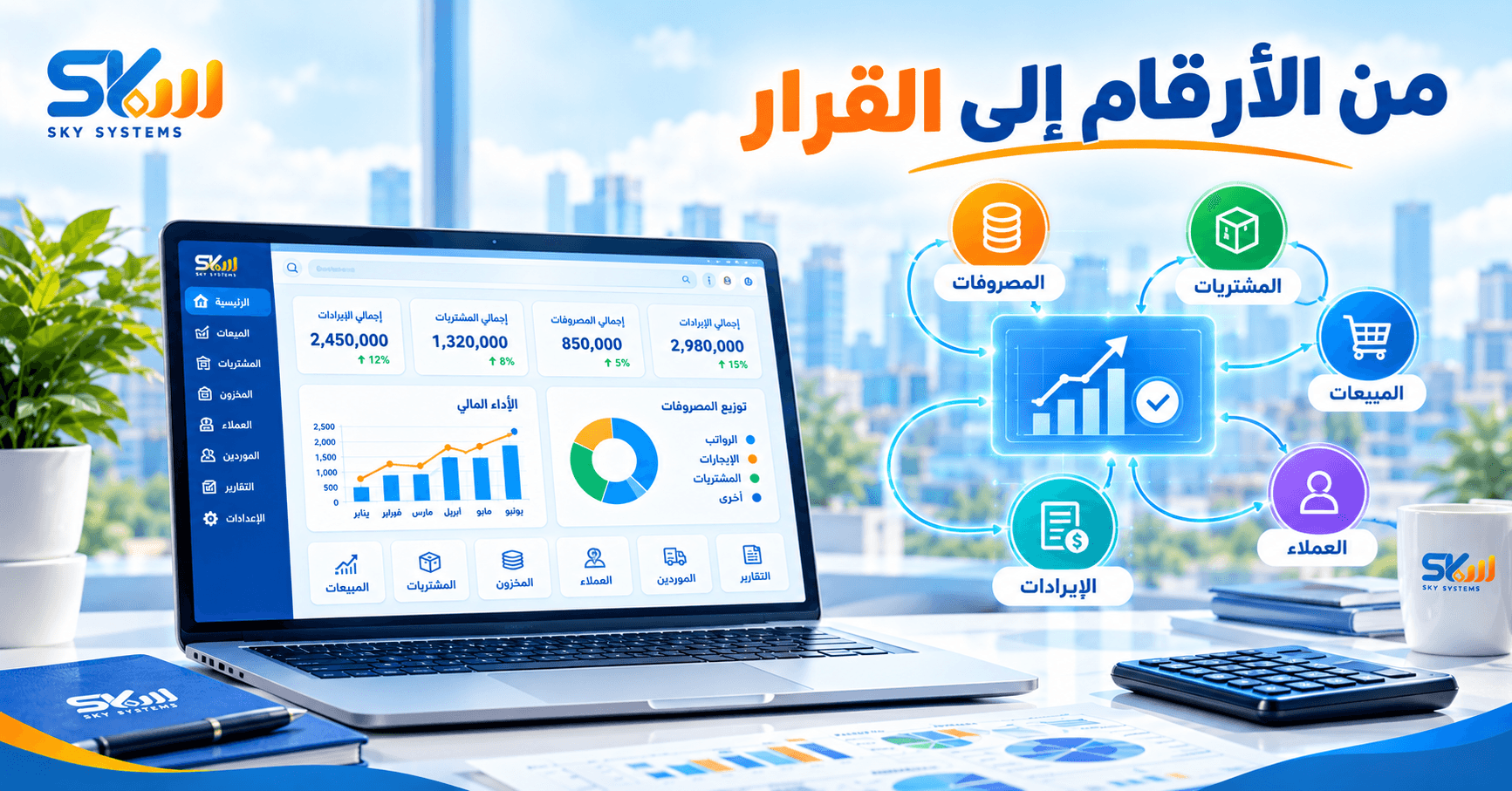
This is where accounting and financial systems help organize this information and connect it to the transactions that generated it.
Management can then access information that helps it understand:
Revenues.
Expenses.
Customers and receivables.
Suppliers and liabilities.
Account movements.
Financial transactions.
Financial reports.
As a result, numbers are no longer simply stored figures.
They become information that can be understood and used.
What About Customers and Suppliers?
A company does not deal with numbers alone.
There are customers who make purchases and payments, and suppliers to whom the company owes amounts. There may also be deferred payments or outstanding balances that require follow-up.
When this data is organized, it becomes easier to know what has been collected and what remains outstanding, as well as what has been paid and what is still due, depending on the system’s capabilities.
This reduces the need to search through multiple files to determine the status of a particular account.
But what happens when the company grows and the volume of data increases?
When the Number of Spreadsheets Starts to Grow
A company may begin with a simple spreadsheet for recording revenues and expenses.
Then another is added for customers.
Another for suppliers.
Then files for invoices.
And more spreadsheets for inventory, payroll, or branches.
At first, this may seem manageable.
But over time, questions begin to arise:
Where is the information?
Has it been updated?
Do the figures match?
Who modified them?
Can a report be generated quickly from this data?
At this point, accounting software may become more useful than managing data across scattered files.
But is accounting software the right solution for every company?
When Is Accounting Software Enough?
If a company’s needs are primarily focused on accounting, accounting software may be the right choice.
It can help organize accounts, revenues and expenses, invoices, customers and suppliers, reports, and other accounting functions depending on the system.
But some companies do more than accounting.
They have sales, inventory, purchases, branches, employees, and multiple operations that need to be connected.
This raises another question:
When is accounting software no longer enough on its own?
When a Company’s Needs Go Beyond Accounting
If a company needs to connect accounting with sales, inventory, purchases, branches, and other operations, it may need a more integrated financial or business management system.
The point is not that accounting software is inadequate.
Rather, the company’s needs have grown beyond the scope of accounting alone.
An integrated system may therefore be more suitable, as it can help connect different operations so that each department does not operate in isolation.
Ultimately:
Accounting software organizes the numbers, while an integrated system helps connect those numbers to the operations that generated them.
In the End…
A good accounting and financial system is not designed simply to record numbers.
It helps the company organize its operations, monitor accounts, understand revenues and expenses, and access the information and reports management needs.
Most importantly, choosing a system should begin with the company’s actual needs.
The question is not:
Which system has the largest number of features?
It is:
Which system can help my company manage its business more clearly and efficiently?
Discover Sky Systems Solutions for Accounting and Business Management →