Financial Reports
The Story Begins with the Transaction
When an employee records a financial transaction, the required data is entered according to the nature of the transaction.
This data becomes part of the company’s records.
As transactions continue, the data accumulates.
One transaction after another.
Day after day.
Month after month.
Eventually, management needs to turn this large amount of data into information that is easier to understand.
This is where reports come in.
A Report Summarizes Thousands of Transactions
Imagine a company that completes thousands of transactions in a single month.
Can management review every transaction one by one to understand the company’s position?
Of course not.
This is where reports become valuable.
A report takes a large amount of organized data and presents it in a way that helps management understand a specific aspect of the business.
Depending on the system’s capabilities, there may be reports covering revenues and expenses, customers, suppliers, branches, transactions, or accounts.
In other words:
A report does not replace the data… it makes the data easier to understand.
Why Aren’t Numbers Alone Enough?
A company may have a report showing that its revenues have increased.
But does that necessarily mean the company is performing better?
Not necessarily.
Expenses may have increased as well.
There may be outstanding amounts that have not yet been collected.
And performance may vary from one branch to another.
That is why management needs more than a single number.
It needs to see a set of related indicators and information.
This is where the quality of a report becomes closely connected to the quality of the data behind it.
What Happens If the Data Is Not Organized?
If transactions are incomplete, duplicated, or recorded incorrectly, the reports generated from them may also be affected.
This highlights an important point:
A good report starts with a well-recorded transaction.
A system cannot turn disorganized data into reliable information simply by pressing a button.
That is why report quality begins with how transactions are recorded and how data is managed.
How Do Reports Help Management?
Reports help management see what is happening instead of relying on impressions.
They can help identify:
Transaction volume.
Revenues and expenses.
Branch activity.
Customer balances.
Amounts due to suppliers.
Changes over a specific period.
Indicators that require attention.
This information can help management make better decisions.
But a report is not the decision itself.
A report gives you a picture… management interprets that picture and makes the decision.
Daily or Monthly Reports?
Reports vary according to the company’s needs.
Management may need daily monitoring for certain transactions.
It may need weekly or monthly reports for comparison and analysis.
It may also need detailed reports when reviewing a specific transaction.
This highlights the importance of having a system capable of providing information according to the needs of the business.
From Data to Decisions
Let’s take a simple example.
If a report shows that one branch has experienced a continuous increase in expenses, this is not the decision itself.
It is information that leads management to ask:
Why have expenses increased?
Is it because the branch has expanded?
Or because the number of employees has increased?
Or because of unusual expenses?
Or because the nature of the business has changed?
This is how reports move beyond being simple numbers and become a starting point for analysis.
In the End…
A financial report is not simply a page filled with numbers.
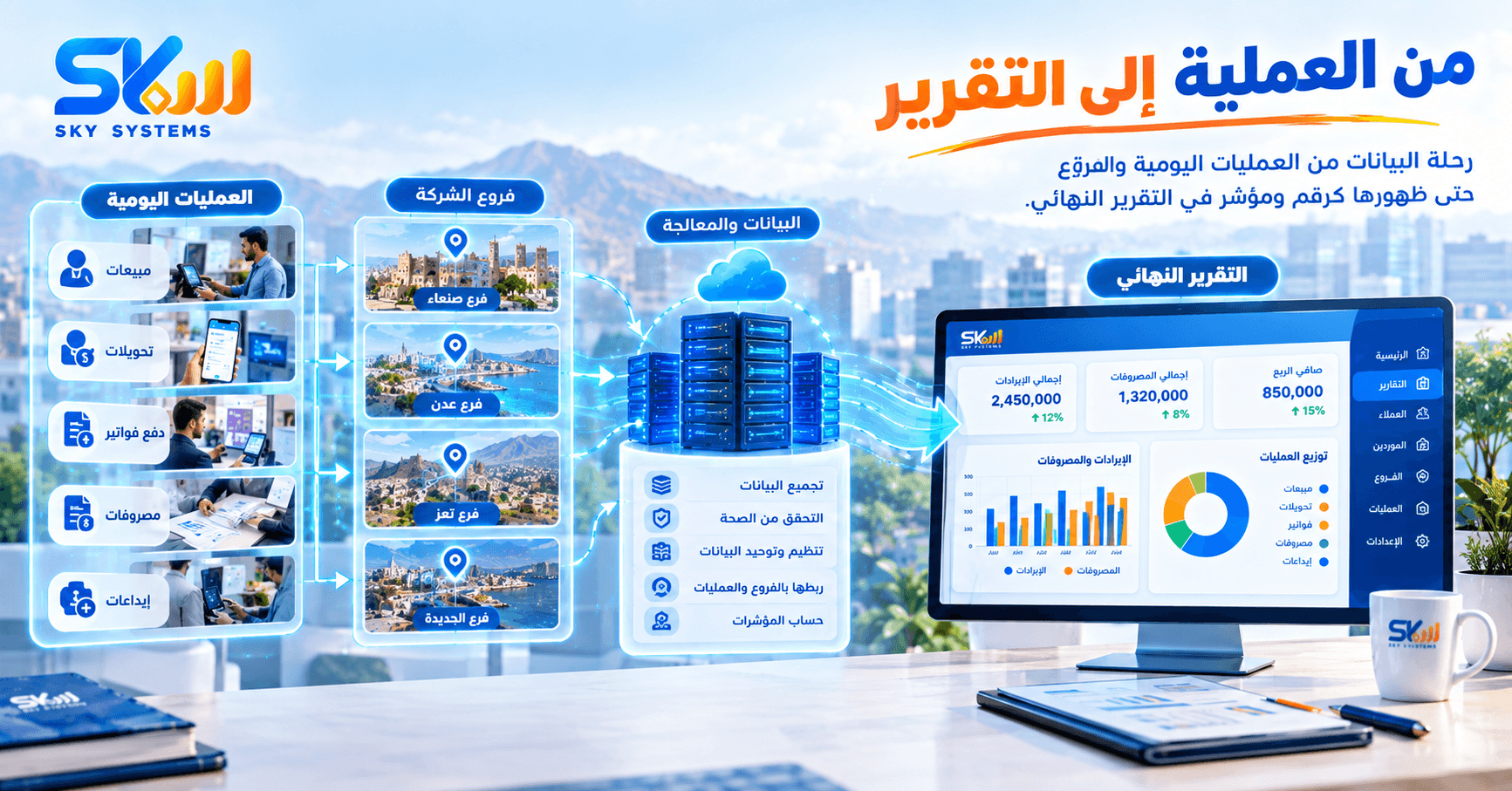
It is the result of a process that begins with a transaction, followed by recording the data, organizing it, processing it, and presenting it in a way that helps management understand it.
Behind every number in a report is a transaction.
Every transaction generates data.
And organized data is what creates a report that can provide real value.
That is why the value of a system does not appear only when it records a transaction.
It becomes truly valuable when it helps management understand what those transactions mean.
Discover the Capabilities of Sky Forex Pro for Reporting and Financial Management →